Measuring what actually matters. Life cycle assessment, EPDs and whole life carbon — the tools and methods for understanding and reducing the carbon cost of every building decision.
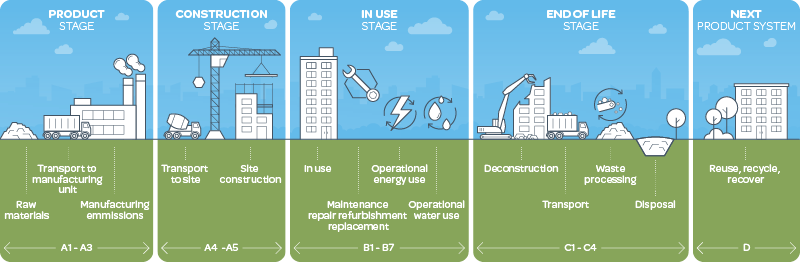
You cannot reduce what you cannot measure. Whole life carbon assessment is the discipline that puts numbers on the carbon cost of a building across its entire life — from the extraction of raw materials through construction, operation, renovation and eventual demolition. It is the only way to understand the true climate impact of a design decision, a material choice, or a procurement strategy.
Two tools sit at the heart of this discipline. Life Cycle Assessment — LCA — is the methodology. It defines how carbon is calculated, what system boundaries are drawn, and which life cycle stages are included. Environmental Product Declarations — EPDs — are the data. They are standardised, third-party verified documents that state the carbon footprint of a specific material or product, giving architects, engineers and contractors the numbers they need to make informed specification decisions.
Together, LCA and EPDs are becoming the common language of low-carbon construction across Europe. They underpin RE2020 compliance in France, BREEAM and LEED credits across the continent, CSRD scope 3 reporting for developers, and EU Taxonomy alignment for investors. Understanding them is no longer optional for anyone serious about circular or low-carbon construction.
This category is for the practitioners doing this work. Share methodologies, compare tools, debate system boundaries, ask about specific EPDs, discuss certification processes, and help each other produce assessments that are rigorous, useful and comparable.
The numbers matter. This is where we get them right.